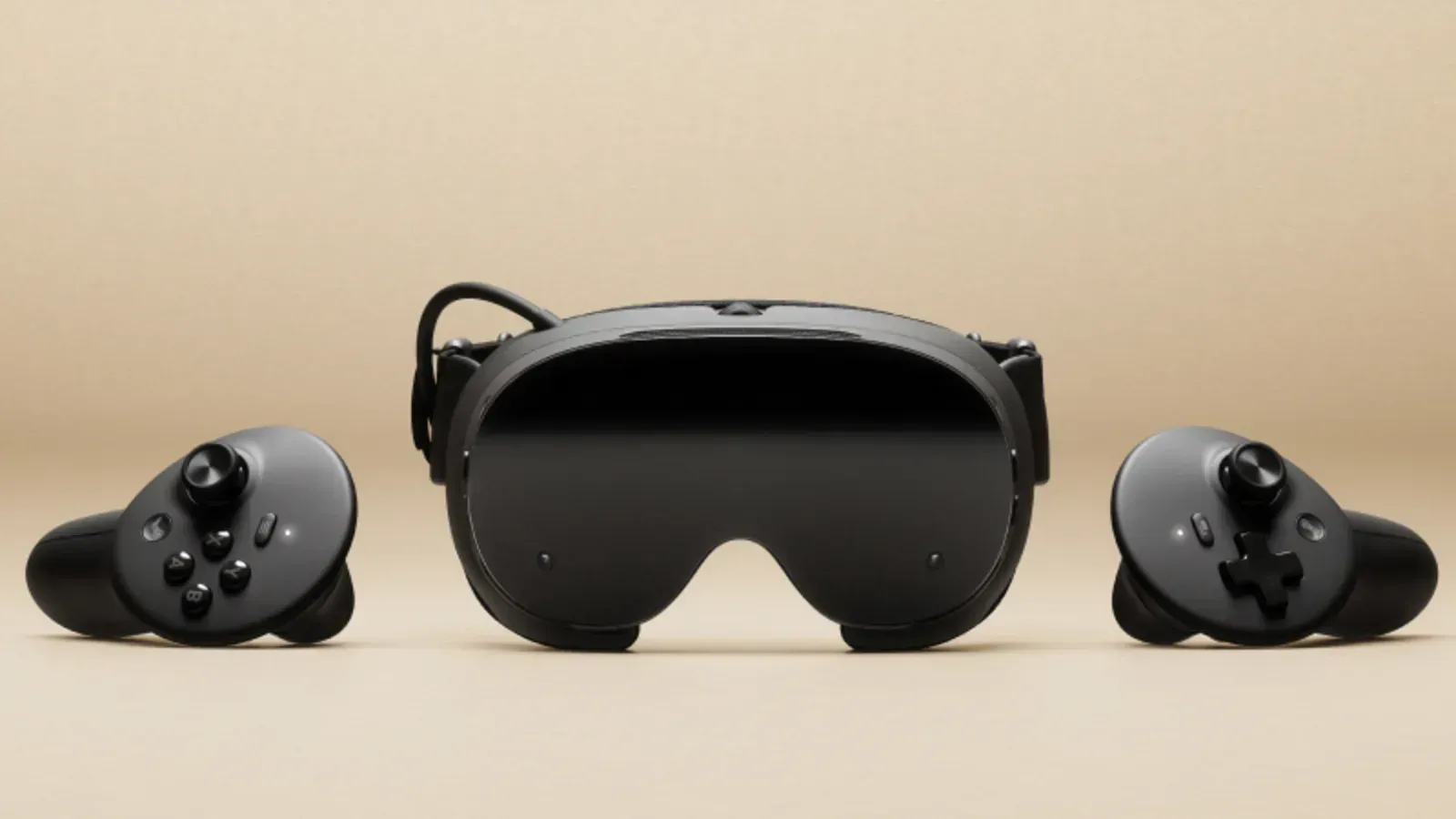
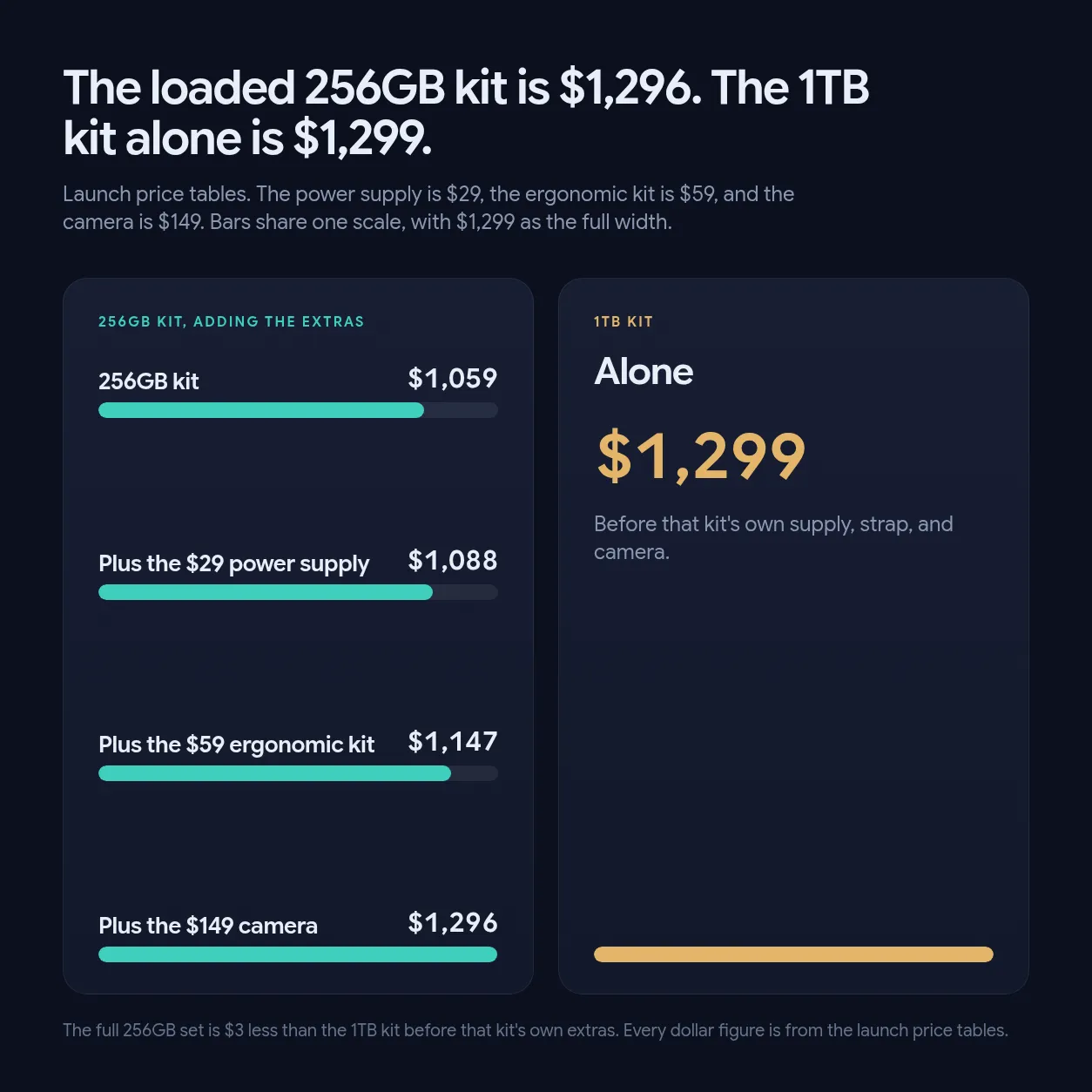
Valve released Steam Frame on September 14, 2026. The 256GB Kit is $1,059 and the 1TB Kit is $1,299. Both kits include the Steam Frame Controllers, a Wi-Fi 6E adapter, and Half-Life: Alyx. The power supply is not included. Valve is allocating early units by reservation rather than open sale.
UploadVR and Road to VR's price story print those US kit prices. Road to VR's review, and its separate Alyx story, round the starting price to $1,060. This piece uses $1,059 and $1,299. The same price stories also list Canada, the eurozone, the UK, Australia, and Poland, so a buyer outside the US should use those figures.
What the kit leaves out
Valve sells a power supply for $29. UploadVR says the headset charges over USB-C and that the box has no charger. The reports price Valve's own supply and never name a wattage, so they leave a charger you already own untested.
The ergonomic kit is $59 in the price tables. It includes a top strap, controller hand straps, battery doors for those straps, and an extended light blocker for the nose. Road to VR's review calls the same kit $60. The reviewer found the headset a bit more comfortable than a Quest 3 with the battery at the back, and a lot more comfortable once the top strap was on. That review weighed the headset at 435 grams, against 515 grams for a Quest 3, and called the result 16 percent lighter. TopVRNews lists the headset at 440 grams.
The Arcturus Vision Camera is $149 in UploadVR's product report. The review and Road to VR's buyer primer both say $150. It weighs 10 grams, attaches at the expansion port under the nose, and replaces the built-in passthrough with color. UploadVR's full mode is 2464 by 2464 per eye, about 6 megapixels, at up to 72 Hz, with 60 Hz as the default. A half-resolution mode is marked experimental at up to 144 Hz, and UploadVR warns that the higher rates can flicker under artificial light. The camera also records tracked 3D video, and it costs battery life while it is switched on. The primer said the first camera batches were due from September 20.
Launch reports describe the built-in view as grayscale, with a tint you can set. The review says that view is not sharp enough to read a phone. UploadVR's comparison table puts the built-in image at 1.3 megapixels in grayscale and the camera at 6.1 megapixels in color. TopVRNews still lists the passthrough as color, taken from a secondary spec database, and notes that Valve's developer page does not describe the image.
Alyx is listed with the kit, and the port date is disputed
TopVRNews lists Half-Life: Alyx with both kits. UploadVR's price story matches that and adds the delivery details. A native build runs on the headset with no PC. Buyers who do not already own the game get a copy. Valve made no content changes, so existing Workshop items work, and Steam Cloud saves can move between the standalone version and a PC session. UploadVR says eye-tracked foveated rendering is the breakthrough that made the port viable.
Road to VR published an Alyx story the same hour that says the port will not be ready at launch. Valve's line in that report is that the port is "intended to ship to customers soon." The story also says Valve had not confirmed a free copy, and that inclusion might follow the Index, where the game was free with the headset. That article uses the rounded $1,060 price and says shipping could begin as early as September 18.
The included copy is the claim TopVRNews is carrying, and it matches UploadVR. Whether the first reserved units can play the standalone port on the day they arrive is the claim those two launch-day reports do not share.
Reservation emails, then screenshot listings
You register for one storage size. Valve randomized the queue for people who signed up by September 17 at 10 am Pacific Time, the same approach it used for Steam Machine. Valve expected to send the first purchase emails on September 18. Anyone past the number of units on hand went to a waitlist, and Valve has not published that number. Signups after the cutoff go to the back of the queue.
Road to VR's price story says the first units should arrive shortly after those September 18 emails. Its Alyx story says shipping could begin as early as September 18 itself.
On September 17, UploadVR reported eBay listings that had been up since reservations opened on September 14. Some sellers posted a screenshot of a queue place. The warning in that article is concrete. A screenshot is easy to copy and alter. On that date, a seller who did not already hold a dev kit could not have had a delivered customer unit. UploadVR also pointed at the Steam Controller, a $100 accessory with listings as high as $300, and some buyers told to wait until 2027. Pay Valve through the reservation email.
Who the review says should buy it
Road to VR published its review on September 16. Valve supplied the headset. TopVRNews's buying note still says owner evidence is limited, and it says there is no review. Road to VR has since reviewed one headset Valve supplied. Customer reports are still scarce while Valve allocates units by reservation.
The review recommends the headset to people who will tinker with settings. It would not recommend it to someone new to VR, or to someone who wants the simpler device. Quest 3 already streams PC VR and already has a large standalone library. The review puts Frame's extra room against a $460 gap, using a $1,060 Frame and a $600 Quest 3.
On the picture, the review says the two headsets are close in size, field of view, and visual performance, with a clarity edge to Quest 3. Frame's pancake lenses come close, and a bit more resolution does not become a clearly better image until games are optimized for it. Tracking is Valve's first inside-out system on a headset, and the reviewer had no complaints about head or controller tracking. There is no hand tracking. The controllers can stand in for a gamepad, with a D-pad and the face buttons on the right controller. The buyer primer says each controller uses a replaceable AA battery rated up to 40 hours.
The included adapter is the streaming path. The review says an average person would not separate the wireless image from a tether by delay or sharpness, and that whole sessions were less reliable than Steam Link on a Quest 3. Games sometimes failed to start, failed to quit, or hung while loading. UploadVR's price story adds two changes Valve made after the original reveal. Multi-Link uses the adapter and local Wi-Fi together and picks the lower-latency path for each packet. A sharpening pass from AMD runs on the PC.
The two Road to VR pieces do not agree on battery life. The September 14 primer says the headset has over two hours, and says that testing was still underway. The review measured 1 to 1.5 hours of mixed use on default settings, switching between a Performance preset and a Playtime preset, against about 2 hours on a Quest 3.
Certified games are the standalone library the review trusts. Demanding or poorly optimized games are largely unplayable on the headset itself. Flatscreen games that are already well optimized can work. The review names Hades II, Balatro, Portal 2, and Deep Rock Galactic as playable, and it names Helldivers 2, Battlefield 6, and Marathon as games that run poorly. The menus are Steam Deck and SteamVR layered on each other, and the reviewer says the interface needs a rebuild. A Linux desktop, including Chrome, opens from the dashboard.
The primer says a magnetic spacer for glasses is in the box, that fit depends on how wide the frames are, and that Zenni prescription inserts are planned with no date and no price. Other insert makers are already advertising Frame lenses. A microSD slot can add storage, and the primer caps that slot at 2TB.
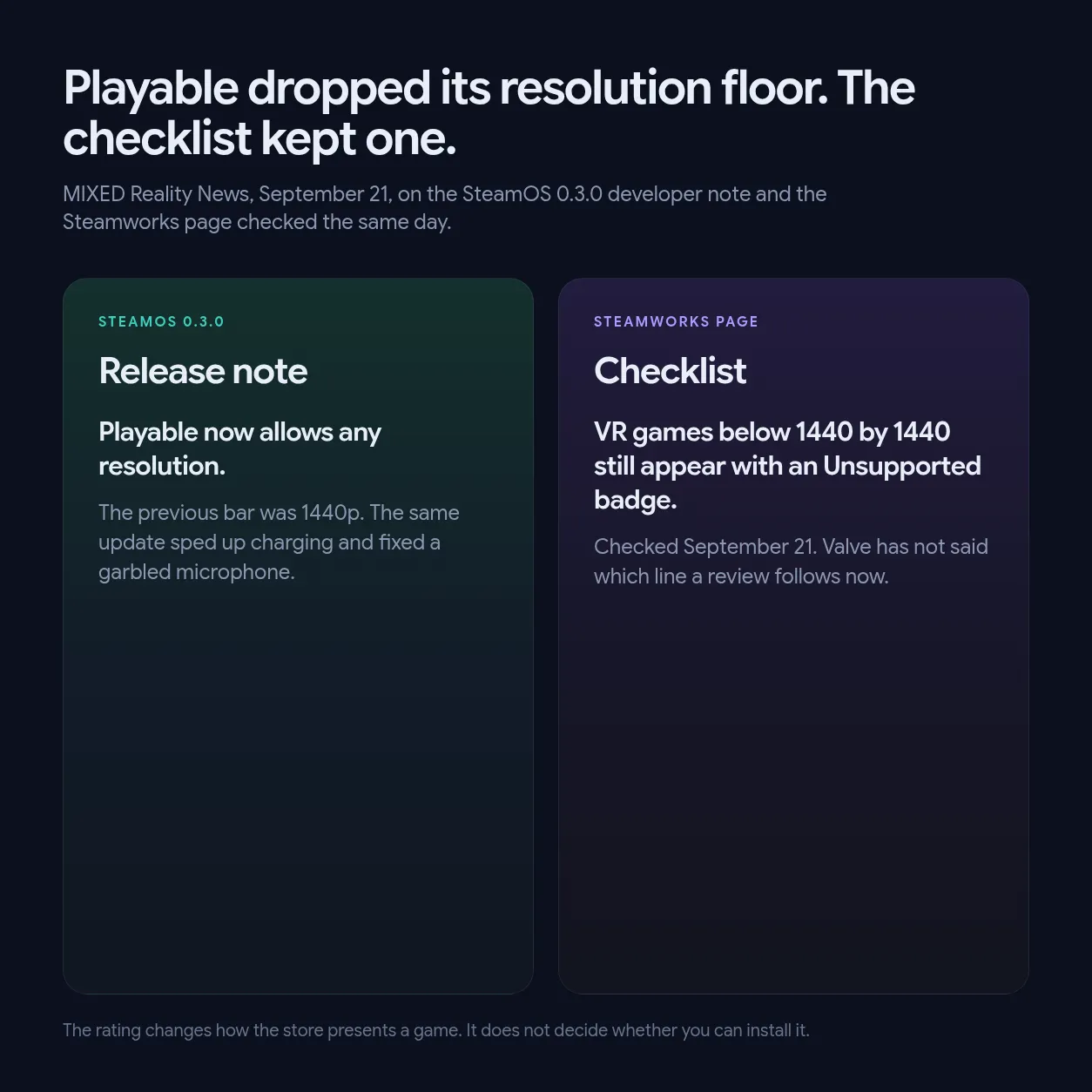
Playable dropped its resolution floor, and the checklist kept one
SteamOS 0.3.0 is the headset's first system update. MIXED Reality News, on September 21, quotes the developer note. Playable performance criteria now allow any resolution. The previous bar was 1440p. The same update sped up charging and fixed a garbled microphone. The resolution line is the part written for developers.
MIXED gives Valve's four labels. Verified means the game passes every check. Playable means it runs, and it may need a community controller config or a settings change. Unsupported means it does not run, because of Proton or a hardware limit. Unknown means nobody has reviewed it yet. A Verified VR game has to hold at least 72 frames per second at 1728 by 1728 in normal play. A Verified 2D game has to hold 30 frames per second at 1280 by 720. Most failures of that performance section become Playable. Valve has not published a frame-rate floor for Playable.
The public checklist still conflicts with the release note. Checked on September 21, the Steamworks page still said VR games below 1440 by 1440 appear with an Unsupported badge. Valve has not said which line a review follows now, and it has not said how many games change label.
The badges cover games running on the headset, both 2D and VR. They do not cover a game streamed from a PC, so an Unsupported label can sit on a game that streams well. The rating changes how the store presents a game. It does not decide whether you can install it.
The counts from this month are different lists.
UploadVR's price story on September 14 names 70 other VR games with a Steam Frame Verified tag, separate from the Alyx announcement. Its Great on Frame article, republished that day from a July piece, says Valve has certified at least 70 VR games and that the list will keep changing. Road to VR on September 16 says the Great on Frame page has grown from a half-dozen titles in July to more than 130 games and apps. Flatscreen games are about half of the featured titles, including Hollow Knight: Silksong, Portal 2, and Hades. MIXED says Steam showed 143 Steam Frame Verified games on September 18, and that Valve publishes no count of Playable games.
Verified, Great on Frame, and Playable are three labels, taken on three days. Adding 70, 130, and 143 counts games more than once.