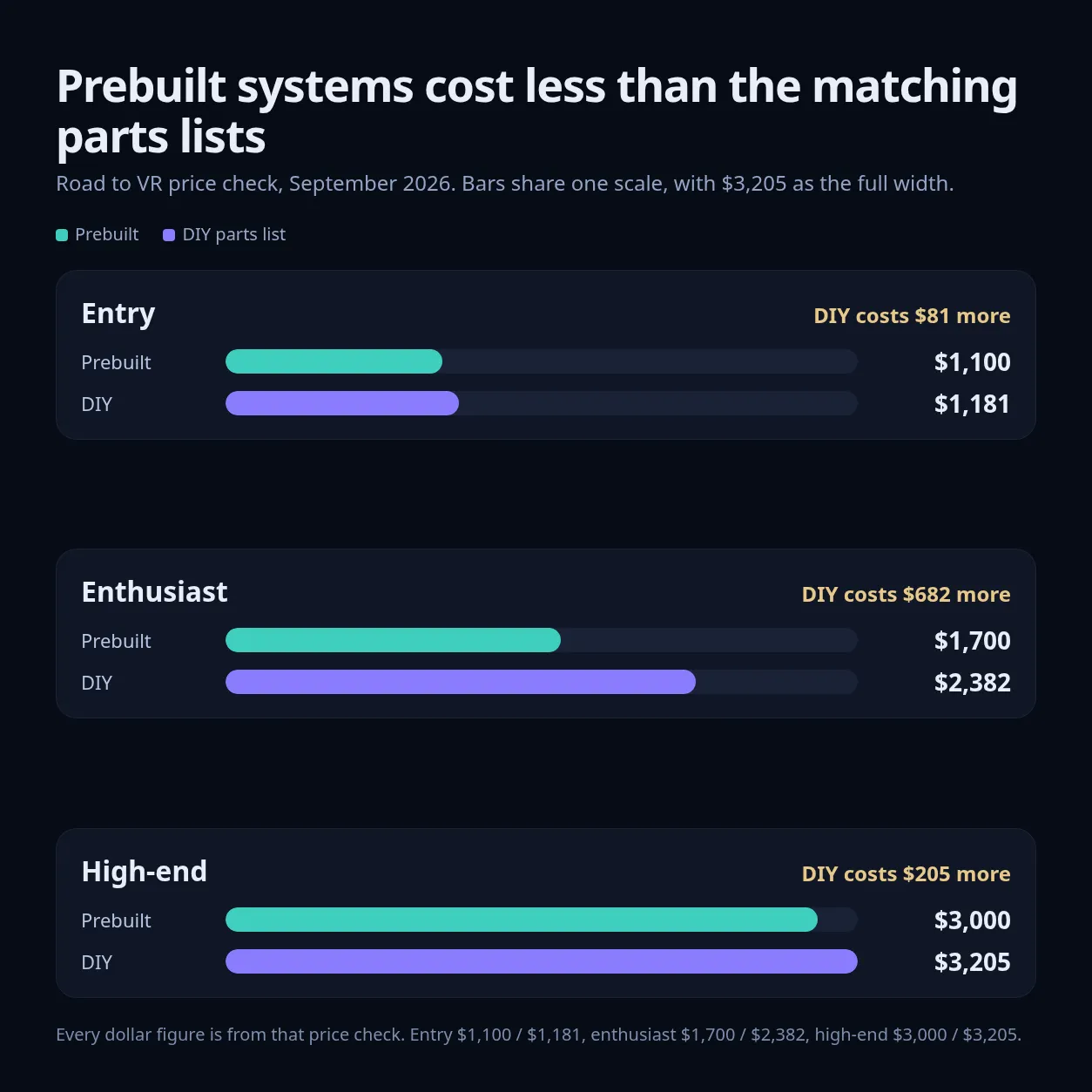
A VR-ready desktop starts around $1,100 in a September 2026 price check from Road to VR. That entry price is meant for older, directly connected headsets. Current standalone headsets used for PC VR push the suggested prebuilt budget to about $1,700.
The guide divides PCs into three tiers. Its examples use an RTX 5060 system for entry-level VR, an RTX 5070 system for current headsets, and an RTX 5080 system for demanding high-resolution headsets and simulation games.
The three example budgets
The $1,100 entry system pairs an AMD Ryzen 5 5500 with an Nvidia GeForce RTX 5060 with 8GB of video memory, 16GB of DDR4 memory, and a 1TB solid-state drive. Road to VR places headsets such as Valve Index, Rift S, HTC Vive Pro, and Windows Mixed Reality in this tier.
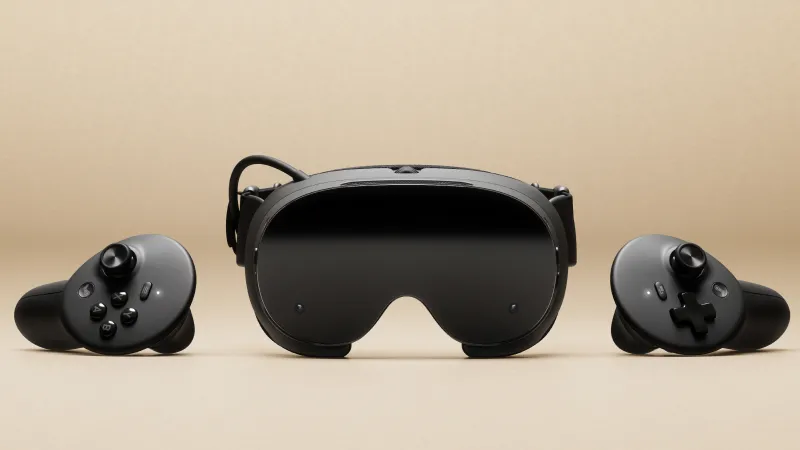
The $1,700 enthusiast system moves to an Intel Core i7-14700F and an RTX 5070 with 12GB of video memory. The guide recommends this class for current headsets such as Quest 3, Quest 3S, PlayStation VR2 used on PC, Pico 4, and Steam Frame.
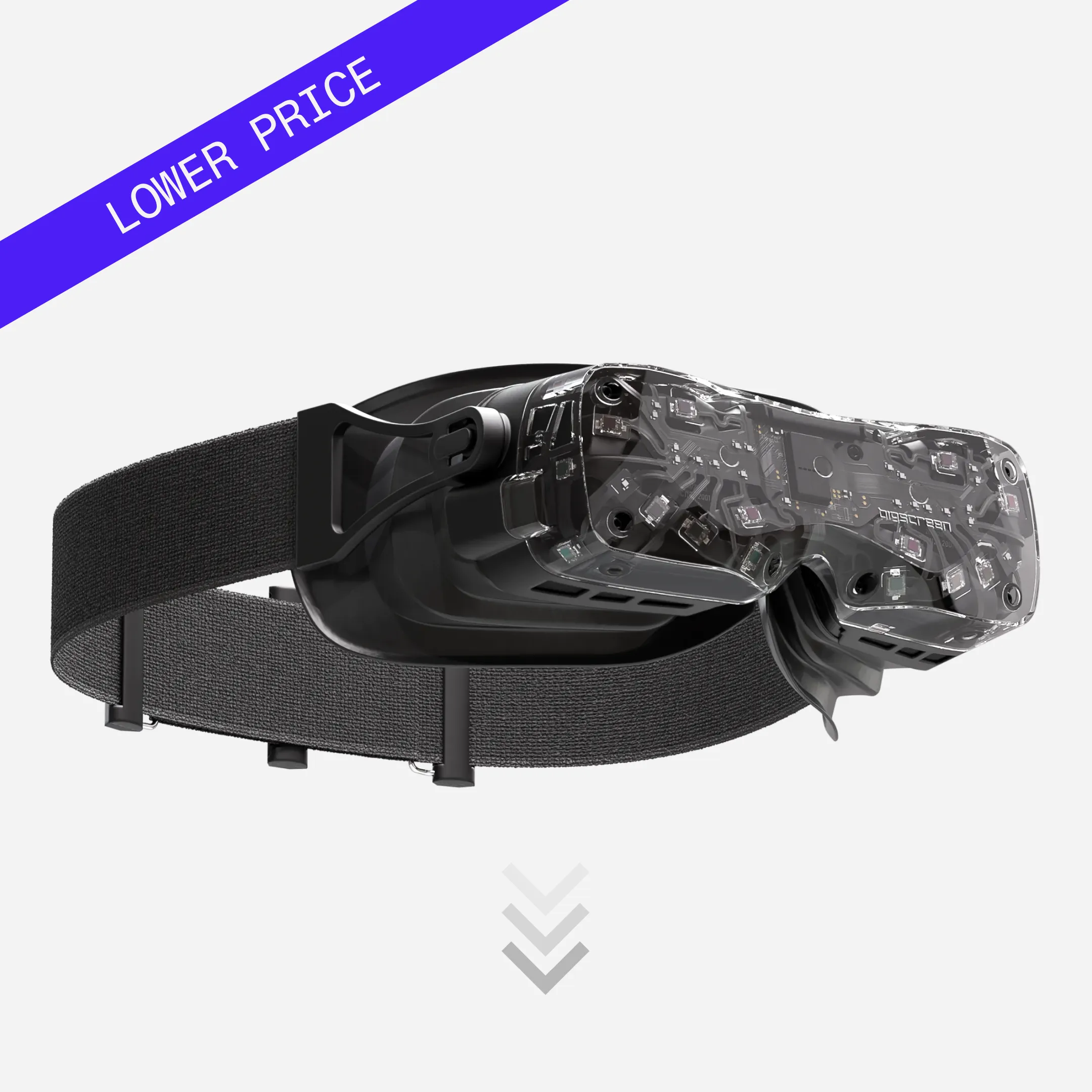
The $3,000 high-end example has an Intel Core Ultra 7 265K, an RTX 5080 with 16GB of video memory, 32GB of DDR5 memory, and a 2TB solid-state drive. Road to VR connects this tier with high-resolution headsets such as Bigscreen Beyond 2 and Pimax Crystal Super, especially for flight and racing simulators.
These are examples from one price snapshot, not minimum specifications issued by every headset maker. Game settings, render resolution, refresh rate, streaming method, and the software being played can all change what a given PC can deliver.
Wireless and USB streaming raise the target
Quest 3 and Quest 3S can run their native games without a PC. A gaming PC becomes relevant when the headset is used for SteamVR or other PC VR software through a wireless or USB connection.
Road to VR puts those headsets in the $1,700 tier because the PC must render the game and encode the video stream sent to the headset. A directly connected headset does not use the same video compression path.
That does not mean every Quest owner needs an RTX 5070. It means the $1,100 example was chosen around older tethered hardware, while the $1,700 example gives more room for current rendering loads and streaming overhead. Buyers should start with the requirements of the games they plan to play, then check the headset connection method.
How to choose the tier
Start with the headset and the most demanding game you expect to run. A Valve Index playing older PC VR games has different needs from a Pimax Crystal Super running a flight simulator at high resolution.
Then check the graphics card's video memory, the PC's ports, and the connection path. Wireless Quest streaming also depends on the local network, so a faster GPU cannot repair a weak Wi-Fi setup.
Finally, compare the complete prebuilt price with the complete parts list. Include Windows, the power supply, cooling, and storage rather than comparing only the processor and graphics card. In this price check, the full-system totals favor the prebuilts across all three tiers.
Every figure above comes from the Road to VR price check dated September 2026.